On the afternoon of April 28, 1988, a routine 35-minute hop from Hilo to Honolulu, Hawaii, turned into one of the most terrifying—and miraculous—episodes in aviation history. What was supposed to be a standard inter-island flight became a masterclass in pilot skill, structural resilience, and sheer survival against all odds.
The Moment the Sky Opened
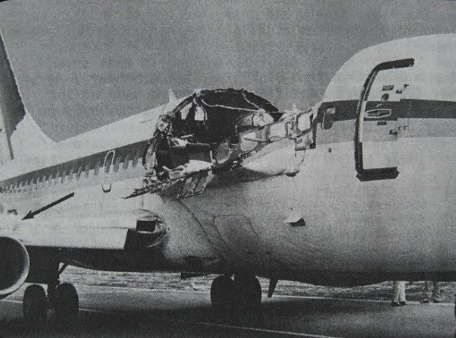
Aloha Airlines Flight 243, a Boeing 737-200, was cruising smoothly at 24,000 feet with 90 passengers and 5 crew members on board. Suddenly, a loud “whoosh” ripped through the cabin. In a split second, an 18-foot section of the upper fuselage completely tore away, instantly exposing the passengers to the open sky, sub-zero temperatures, and hurricane-force winds of over 300 mph.
The decompression was explosive. Passengers seated in the front rows looked up to see nothing but blue ocean and sky. Debris flew through the cabin, and the aircraft began to roll and shake violently as the remaining structure fought against the aerodynamic drag.

A Tragic Loss and Heroic Actions
Tratingly, the accident claimed one life. Chief Flight Attendant Clarabelle Lansing, a beloved 37-year veteran of the airline, was standing in the aisle handing out drinks when the roof tore off. She was instantly swept out of the aircraft by the decompression. Despite extensive search efforts over the following days, her body was never recovered.
The other flight attendants, though injured and pinned down by the wind, managed to keep passengers calm and secured in their seats.
Up in the cockpit, Captain Robert Schornstheimer and First Officer Madeline Tompkins felt the plane drop and roll. When Schornstheimer looked back, he could see the sky through the cockpit door gaps. With communication severely hampered by the deafening roar of the wind, the pilots donned their oxygen masks and began an emergency descent.
The Miracle Landing
The aircraft was severely compromised; the controls were stiff, and the pilots feared the plane would literally snap in half under the immense pressure. Yet, through incredible skill and calm under pressure, Captain Schornstheimer guided the shaking Boeing 737 toward Kahului Airport in Maui.
Against all aerodynamic laws, the pilots successfully landed the plane at 1:58 PM, just 13 minutes after the explosion. Out of the 95 people on board, 65 were injured (several severely), but miraculously, 94 survived.
The Legacy of Flight 243
The National Transportation Safety Board (NTSB) investigation concluded that the disaster was caused by metal fatigue exacerbated by corrosion. The aircraft had been operating in a humid, salty marine environment and had completed over 89,000 flight cycles (takeoffs and landings)—the second-highest of any 737 in the world at the time. The constant pressurization and depressurization had created microscopic cracks around the rivets until the hull simply gave way.